
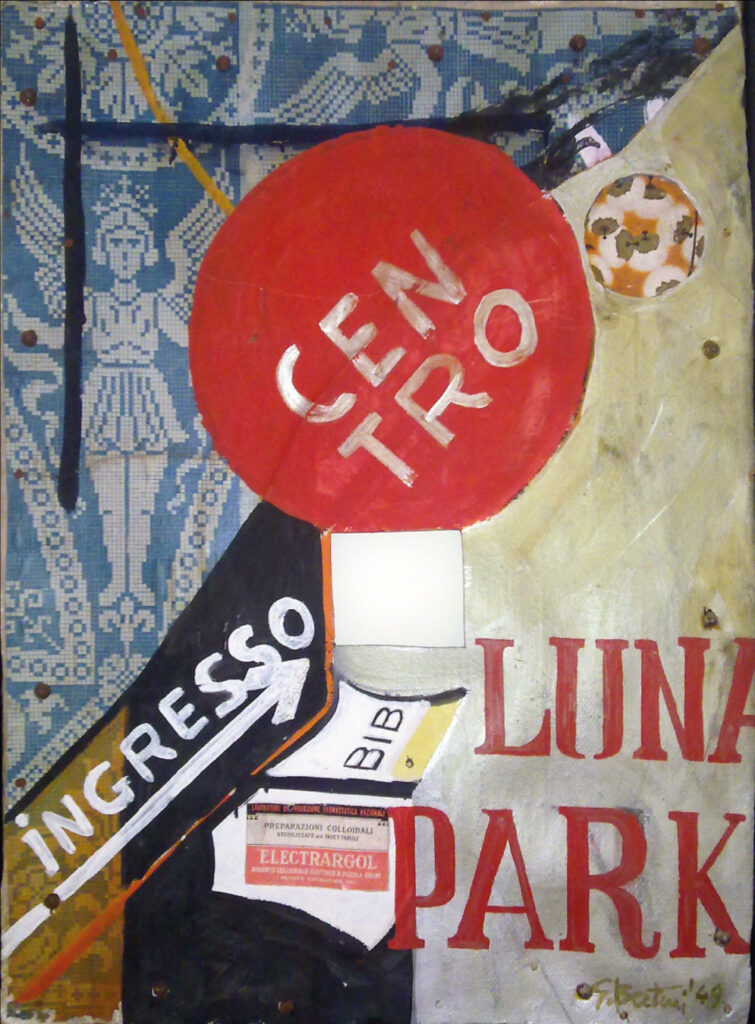
From 16 May to 13 September, Fondazione Biscozzi | Rimbaud, in partnership with Gianni Bertini Association (Milan) and Frittelli Archive for the work of Gianni Bertini (Florence), presents the exhibition Gianni Bertini. The Story of a Man with no History, curated by Thierry Bertini and Roberto Lacarbonara, dedicated to one of the most original and reliable artists, who, working between Italy and France, was the pioneer and forerunner of the cultural European transformation in the second post-war period.
The exhibition dedicated to Gianni Bertini (Pisa 1922 – Caen 2010) centres around the exhibition proposal that Fondazione Biscozzi | Rimbaud elaborates starting from the dialogue with the authors of the permanent collection, so as to better understand and investigate contexts, languages and events of the artistic research of the Twentieth Century.
The title of the exhibition, The Story of a Man with no History – taken from the eponymous unpublished novel that the artist wrote in 1953 and recites on the occasion of a happening in Campo San Fantin in Venice on the night of August 11th – represents a veritable manifesto, able to aliment the entire vision and complexity of Gianni Bertini career. A production which, by virtue of a continuous displacement from conformism, saw him grippling with new directions, expressive and linguistic evolutions and a certain stubborn heresy, result of a constant technical experimentation and a fearless wandering.
“He desperately needed an exchange with other artists and critics – points curator Thierry Bertini, son of the artist – an exchange that often became a discussion. He did not fear making intellectual enemies: for him the debate, also heated, was a daily need. The clash of ideas was the fertile land from which his own point of view could emerge”.
The exhibition of more than 40 works and a selection of artist books – including the unpublished novel that lands its title to the exhibition – focuses on a specific phase of the work of Bertini, one of the most original and engaging, spanning from 1946 and the 1970s, exploring three main areas of his research: from the Gridi (Shouts) of the 1940s, to the large informal production of the 1950s and to the following creation and development of Mec-Art.
This was a period in which the artist showed a brilliant ability to recapture the revolutionary spirit of the early 20th Century avant-garde-movements – from the Futurism to Dadaism – whilst at the same time anticipating a visual culture increasingly ruled by the mass communication, industrial mass production and the logic of capitalist production.
I GRIDI: In 1949, on the occasion of the international exhibition Arte d’Oggi at Galleria La Strozzina in Florence, Bertini presents the cycle of Gridi (Shouts), paintings created using stamped letters and numbers. Not related with any specific current, these works form compositions based on alphanumeric elements, cardinal points, road signs and geometric shapes, anticipating the stylistic motifs that, ten years later, would characterise New Dada and Pop Art.
THE INFORMAL ART PERIOD: Starting from 1951, also thanks to his contacts with the critic Gillo Dorfles and with the artists of M.A.C. (Movimento Art Concreta), the research of Bertini turned towards Informal Art. His works show a greater expressive freedom and focus of the deep tensions of the reality through sign-gesture, “dripping” and the material. In October of that same year, he moved to Paris, where he got in contact with the critic Pierre Restany.
The early Parisian exhibitions mark a clear evolution and introduce the ‘mechanical turn’ in his work: Bertini draws on formal elements linked to the electrical and mechanical imaginary, signs of an artificial and technological dimension of the contemporary society.
MEC-ART: Starting from 1963 Bertini experiments with new techniques coming from the world of mechanical and mass reproduction: photographic images transferred onto emulsion-coated canvas or metal and then reworked in a painterly manner. The mechanisation of painting also reveals an intention to challenge the myth of the painting as a unique object, an exclusive fetish. With this aim in mind, in 1965 he signed up to the Mec-Art (Mechanical Art) Manifesto promoted by Pierre Restany.
“The adoption of the term ‘Mec’ – writes Roberto Lacarbonara – which emerged from the intuitions of Restany and the exhibition Homage to Nicéphore Niépce that he curated in the spring of 1965 at Galerie J in Paris, is linked, for Bertini, both to the proposal of a ‘mechanical painting’ capable of prioritising the analogue process of reproduction, acquisition, transposition and re-composition of the image, and to two other decisive aspects of an imagery that had long since matured: firstly, that repertoire of signs and gestures linked to the dynamism of mechanics and its spatial articulations; secondly, a visual framework that incorporates the symbols of advertising, communication and mass society”.
Formula 1 cars, bodybuilders, fashionable objects and clothing, symbols of war, geopolitics and current affairs become, for the artist, a mean of engaging with reality, reinterpreting the visual culture of our time. The Mec aesthetic immediately proves highly topical and represents, to all intents and purposes, the possibility of establishing a European alternative to Pop Art. For Bertini, it is a way of returning to figurative art whilst retaining the expressiveness and authenticity of his early works.
The exhibition is accompanied by a trilingual catalogue (Italian, French and English), edited by Dario Cimorelli Editore, containing essays by the curators Thierry Bertini and Roberto Lacarbonara and the colour reproductions of all the works on exhibition.
INFORMATION SHEET
Exhibition: Gianni Bertini. The Story of a Man with no History
Curated by: Thierry Bertini, Roberto Lacarbonara
Catalogue: Dario Cimorelli Editore, Milan
Exhibition Venue: Fondazione Biscozzi |Rimbaud ETS, piazzetta Baglivi 4, Lecce
Public Opening: 16 May – 13 September 2026
Timetable: from Tuesday to Sunday, 5pm – 9pm. Closed on Monday.
Entrance for the exhibition: €5,00.
Permanent collection + exhibition: € 8.00. Reduced: € 5.00 (for groups of more than fifteen people residents in Lecce and in the province, children under eighteen, primary and secondary school groups, students of university, art academies and conservatories with booklets, teachers, ICOM members). Free admission for children up to six years old, disabled (and a companion), a companion for each group, tourist guides and journalists with ID cards.
Info: www.fondazionebiscozzirimbaud.it | info@fondazionebiscozzirimbaud.it | segreteria@fondazionebiscozzirimbaud.it |tel. 0832 1994743
Instagram: fondazionebiscozzirimbaud; Facebook: Fondazione Biscozzi Rimbaud
Share with: #fondazionebiscozzirimbaud