
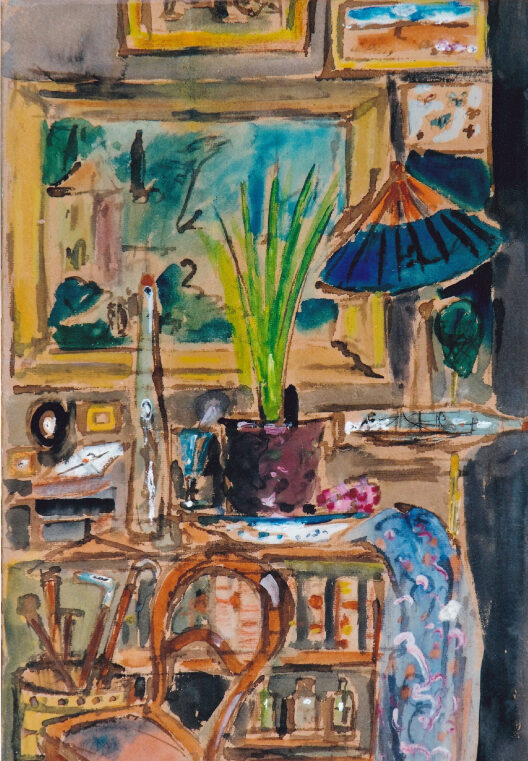
From 14 February to 10 May 2026, Fondazione Biscozzi | Rimbaud, in partnership with the Association for Filippo de Pisis, presents the exhibition Filippo de Pisis and les Italiens de Paris, curated by Paolo Bolpagni and Maddalena Tibertelli de Pisis, dedicated to one of the most original and international chapters in the Italian art between the late 1920s and early 1930s.
The exhibition explores the experience of the Italiens de Paris, a group of Italian artists active in the French capital united by an openness towards Europe, as well as a position of partial and conscious “rebellion” against the dominant approach of the Novecento italiano.
The beating heart of the group was the Groupe of Seven, formed by Massimo Campigli, Giorgio de Chirico, Filippo de Pisis, René Paresce, Alberto Savinio, Gino Severini and Mario Tozzi, protagonists of an exhibition season spanning between 1928 and 1933. The group shared cultural references, professional habits and a common vision of the classicism, understood in a modern, Mediterranean anti-dogmatic key, marked by formal freedom, plurality of languages and dialogue with international culture.
Massimo Campigli (1895 – 1971), who worked in Paris since 1919, developed a style between Purism and archaism, inspired by late Cubism and ancient art. After discovering Etruscan art in 1928, he developed a personal language consisting of monumental and timeless female figures, with chalky colours and an almost fresco-like appearance, before devoting himself to mural painting starting from 1933.
Giorgio de Chirico (1888 – 1978), after returning to Paris in 1925, expanded his concept of classicism through new iconographic cycles, oscillating between Metaphysical Art and Surrealism, alongside series inspired by Greco-Roman antiquity, such as horses and gladiators, emblems of monumental Roman culture.
Filippo de Pisis (1896 – 1956), settled in Paris in 1925, refined a free and immediate pictorial language, influenced by Impressionism and the Fauves, characterised by rapid, nervous brushstrokes, often described as a veritable “pictorial shorthand”.
René Paresce (1886 – 1937), arrived in Paris in 1912, he moved from an unorthodox Cubism to an archaic style inspired by 15th-century Tuscan painting, maintaining an independent and cultured position.
Alberto Savinio (1891 – 1952), arrived in Paris in 1926, where he found a full artistic maturity, developing a painting close to Surrealism but still rooted in the metaphysical poetry, based on irony and spectrality, with frequent references to an alienated classicism.
Gino Severini (1883 – 1966), who had been living in Paris since 1906, theorised a new Pythagorean-inspired classicism based on numbers and proportions, applying it to balanced, monumental paintings inspired by the Commedia dell’Arte and ancient mosaics. Between 1928 and 1933, he exhibited regularly with the Italiens de Paris.
Finally, Mario Tozzi (1895 – 1979), played a mediating role between Italy and France, developing an “active classicism” consisting of monumental and metaphysical compositions, in which myth and reality merge in suspended spaces.
The Polish-born critic Waldemar George, a scholar of the Mediterranean classicism, supported and accompanied the group, describing himself as “the only defender in Paris of Italianism considered as a form of plastic art”. He presented them at the 1930 Venice Biennale in a special room entitled Appels d’Italie. Followed by gallery owner Léonce Rosenberg, the Italiens took part in the exhibitions of the “Novecento Italiano”.
The exhibition focuses on the figure of Filippo de Pisis (Ferrara, 1896 – Milan, 1956), starting with his masterpiece painting Dalie (1932), on display in the first room of the permanent exhibition at the Fondazione Biscozzi | Rimbaud in Lecce. A significant collection of over twenty works by the Ferrara-born artist, created between the mid-1920s and early 1930s, provides a direct comparison with a carefully selected group of paintings by the other six members of the Groupe des Sept, belonging to the same period.
“It was not just a chance encounter of painters living more or less permanently in Paris, but also an association connected by a certain commonality of ideals and human and professional customs,” explains co-curator Paolo Bolpagni, emphasising the cultural and creative cohesion that characterised the experience of the Italiens de Paris.
The exhibition highlights similarities and differences within the group, emphasising their shared international outlook and their distance from an Italian context increasingly oriented towards monumentalism, muralism and the “modern classicism” theorised by Margherita Sarfatti.
The exhibition is accompanied by a trilingual catalogue (Italian, French and English), edited by Dario Cimorelli Editore, containing historical-critical essays and the colour reproductions of all the works on exhibition.
INFORMATION SHEET
Exhibition: Filippo de Pisis and les Italiens de Paris
Curated by: Paolo Bolpagni and Maddalena Tibertelli de Pisis
Catalogue: Dario Cimorelli Editore, Milano
Exhibition Venue: Fondazione Biscozzi | Rimbaud, piazzetta Baglivi 4, Lecce
Public Opening: 14 February – 10 May 2026
Timetable: from Tuesday to Sunday, 4pm – 7pm. Closed on Monday.
Open on Sunday 5 April (Easter), 6 April (Easter Monday), 25 April, 1° May 2026
Entrance for the exhibition: €5,00.
Permanent collection + exhibition: € 8.00. Reduced: € 5.00 (for groups of more than fifteen people residents in Lecce and in the province, children under eighteen, primary and secondary school groups, students of university, art academies and conservatories with booklets, teachers, ICOM members). Free admission for children up to six years old, disabled (and a companion), a companion for each group, tourist guides and journalists with ID cards.
Info: www.fondazionebiscozzirimbaud.it | info@fondazionebiscozzirimbaud.it | segreteria@fondazionebiscozzirimbaud.it |tel. 0832 1994743
Instagram: fondazionebiscozzirimbaud; Facebook: Fondazione Biscozzi Rimbaud
Share with: #fondazionebiscozzirimbaud
In the photo:
Details of the work: Filippo de Pisis, Interior of the Paris studio, 1930, Turin, private collection.